Introduction:
Imagine a customer service channel so intuitive that it feels less like a transaction and more like a conversation with a helpful colleague. The classic text-based chatbox has been a workhorse for digital customer service, but a new, more natural contender is rising: voice-enabled AI chatbots. For business leaders, the question is no longer if they should adopt advanced conversational technology, but which form will deliver the best return on investment and customer satisfaction. Is typing destined to be replaced by talking? Let's break down the case for voice versus text to help you decide the right path for your business.
Defining the Key Players
Before we dive in, let's clarify the core technologies at play.
- Text-Based AI Chatbots: These are the familiar chat interfaces on websites and apps. Users type their questions, and the chatbot, powered by AI assistants and Natural Language Processing (NLP), responds with text-based answers.
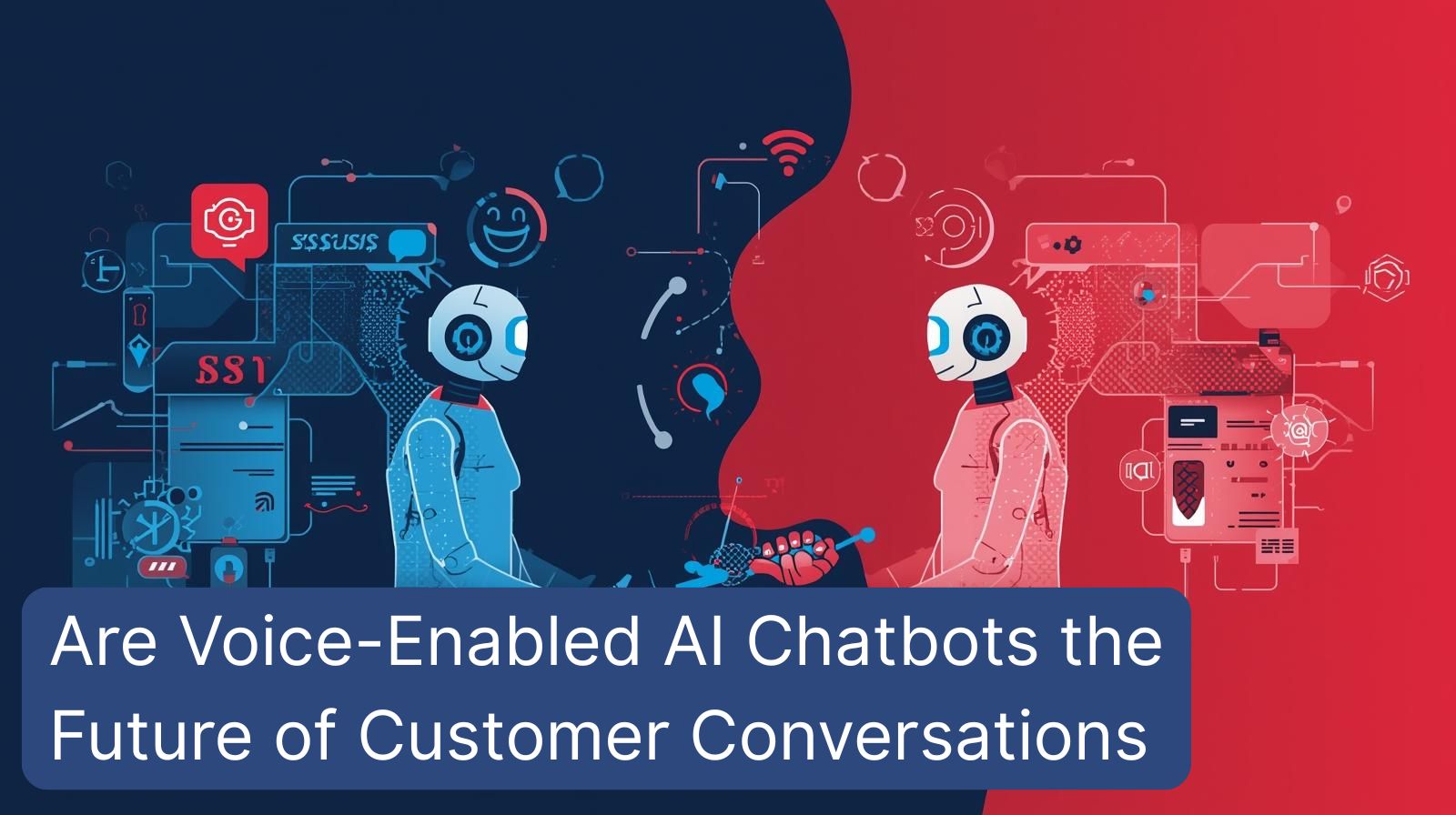
- Voice-Enabled AI Chatbots: These advanced voice chatbots allow users to interact using spoken language. They combine Automatic Speech Recognition (ASR) to understand speech and NLP to process meaning, then respond with a synthetic voice. Think of them as a more specialized, business-focused version of smart speakers like Alexa or Google Assistant.
Voice-Enabled AI Chatbots
Voice interaction represents a significant leap forward in how users engage with technology.
- A More Natural and Frictionless User Experience. Speaking is fundamentally faster and more intuitive than typing for most people. Voice chatbots eliminate the friction of typing on small mobile screens, making them ideal for on-the-go customers or those performing hands-free tasks.
- Higher Accessibility. Voice technology is a game-changer for visually impaired users, those with literacy challenges, or individuals with physical disabilities that make typing difficult. It democratizes access to your digital services.
- The Power of Emotional Nuance. A voice can convey empathy, urgency, or reassurance through tone, pace, and inflection—something text struggles to achieve. This can be crucial for de-escalating frustrated customers or building stronger brand connections.
- Speed and Efficiency for Complex Queries. Describing a complex problem can often be done much more quickly through speech than by laboriously typing it out, leading to faster resolution times.
The Drawbacks of Voice-Enabled AI Chatbots
Despite their promise, voice chatbots are not without their challenges.
- Accuracy and Ambient Noise Challenges. Background noise, strong accents, or specialized vocabulary can lead to misinterpretations, frustrating users and derailing the conversation. This technology is still refining its ability to understand everyone perfectly in all environments.
- Privacy and Security Concerns. Many users are uncomfortable speaking private information (e.g., account numbers, personal details) out loud, especially in public or shared office spaces. This is a significant psychological barrier.
- Higher Development and Integration Costs. Building and training a reliable voice bot is typically more complex and expensive than a text-based system due to the additional layers of speech recognition and synthesis.
- The "Permanence" Problem. Unlike text, a spoken conversation is ephemeral. Users can't easily scan back to review what was said, which can be a disadvantage for instructions or complex information.
Text-Based AI Chatbots
The humble text-based chat is a proven and powerful tool for a reason.
- Accuracy and Clarity. Users can precisely formulate their questions and review the chatbot's responses for accuracy. There's no ambiguity caused by mishearing or accent issues.
- Perceived Privacy and Convenience. Typing feels private. Users can discreetly get support in an open office, on public transport, or anywhere without announcing their business to the world.
- Easier Implementation and Lower Cost. Text-based systems are a more mature conversational technology. They are generally easier and more cost-effective to develop, train, and integrate into existing platforms like CRM and helpdesk software.
- Rich Media Support. Text chats can easily incorporate links, images, videos, and documents (like PDF guides or forms) to enrich the support experience—something pure voice interfaces cannot do.
The Drawbacks of Text-Based AI Chatbots
Text-based systems have their own set of limitations that voice chatbots aim to solve.
- The Typing Barrier. It can be slow and cumbersome, especially on mobile devices. This friction can deter users from even starting a conversation.
- Impersonal and Emotionally Flat. The lack of vocal tone can make interactions feel sterile and robotic. Misunderstandings in text are common and harder to clarify without the nuance of voice.
- Not Ideal for All Situations. They are impractical for users who are driving, cooking, or have their hands otherwise occupied, limiting the contexts in which customers can reach out.
How to Choose: 5 Key Questions to Ask
Your choice shouldn't be based on hype, but on your specific business context. Ask yourself these questions:
- What is our primary customer demographic? Are they tech-savvy early adopters who would embrace voice, or a broader audience that might find text more comfortable?
- In what context do customers typically need support? Is it hands-free (e.g., while using your app for navigation) or in a context where typing is easy (e.g., at a desktop computer)?
- What is our budget for implementation and ongoing training? Are you prepared for the higher initial investment of a voice system, or is a cost-effective text solution a better starting point?
- How complex is the information being exchanged? Does the interaction require the exchange of visual aids (favouring text) or is it purely informational (suited for voice)?
- What are our data privacy and security protocols? How will you handle the unique privacy concerns associated with voice data collection and storage?
The Smart Middle Ground: A Hybrid Approach
The most sophisticated future of customer service may not be an "either/or" choice. A hybrid model offers the best of both worlds. Imagine a system where a customer starts a query via voice chatbots for speed, and the AI assistants seamlessly offer to switch to a text-based interface or send a summary email for complex details or links. This multimodal approach respects user preference and context, ensuring no customer is left behind.
Conclusion
So, are voice-enabled AI chatbots the future? They are undoubtedly a massive part of it, offering an unparalleled level of natural and accessible service. However, text-based AI assistants remain a highly effective, private, and cost-efficient solution for many use cases.
The verdict is clear: Voice is ideal for creating seamless, hands-free, and highly accessible experiences. Text is perfect for ensuring privacy, handling complex information, and maintaining a cost-effective support channel. For most forward-thinking businesses, the ultimate goal should be a flexible, hybrid strategy that lets the customer choose their own path.
Ready to transform your customer experience? 👉 Book your free strategy session with our experts at Digital Solution Lab today. Let's find your solution together.